

Just a month after the Recording Academy announced a brand-new Grammy category for Asian pop music, BTS made one of the biggest statements of their career, by refusing to take part. All seven members announced on 29th July, that they will not submit their return album 'ARIRANG' or any of its songs for the 2027 Grammy Awards, citing the idea that music should never be evaluated based on geography or language.
Their decision has reignited a wider debate about representation, inclusion and whether global artists are still being placed into separate boxes instead of competing on equal footing.


Why BTS Chose to Boycott the 2027 Grammys
When the Recording Academy announced five new Grammy categories for the 69th Grammy Awards, including Best Asian Pop Music Performance, in late June 2026, the uproar started.
The purpose of the award was to honour music from various Asian pop genres, including K-pop, J-pop, C-pop, and other regional forms. BTS had a different opinion of it than many, who regarded it as a step toward more representation.

In a coordinated Instagram statement posted on 29th July, RM, Jin, SUGA, j-hope, Jimin, V and Jung Kook announced they would not submit 'ARIRANG' for Grammy consideration.
The group wrote, "We want our music to be appreciated beyond regional and linguistic boundaries." They added that if they are ever recognized by the Recording Academy, they want it to be because of their music itself, not because it fits into a category based on geography or language.
They went on to say that if they are ever recognized by the Recording Academy, they want it to be for their music itself, not because it falls into a linguistic or geographical categorization.

Their decision applies to the entire 'ARIRANG' album, which marked BTS' first full-group comeback following the completion of all seven members' mandatory military service.
Released on 20th March, 2026, the album became one of the year's biggest global releases and launched the ongoing 'ARIRANG' World Tour.
The Debate Around the New Asian Pop Category
Whether the new category encourages diversity or inadvertently isolates Asian artists from mainstream competition is a major topic of debate. The Recording Academy stipulates that an Asian language must be used extensively in entries for Best Asian Pop Music Performance.

This means that even though they were on 'ARIRANG', tracks like BTS' popular song 'SWIM,' which is performed fully in English, would not be eligible for the category.
Critics contend that classifying musicians largely based on language or region runs the risk of erecting new barriers rather than removing existing ones, particularly for performers that have spent years competing in international pop markets. Discussions on BTS' lengthy Grammy history have also been rekindled by the move.
Despite receiving numerous nominations throughout the years, the group has never won despite making history as the first K-pop artist to get major Grammy nominations.

Ironically, 'Golden' from 'KPop Demon Hunters' won Best Song Written for Visual Media in 2026, marking the first-ever Grammy award associated with K-pop and proving that Korean music is becoming more well-known at the Academy.
How the Recording Academy Responded
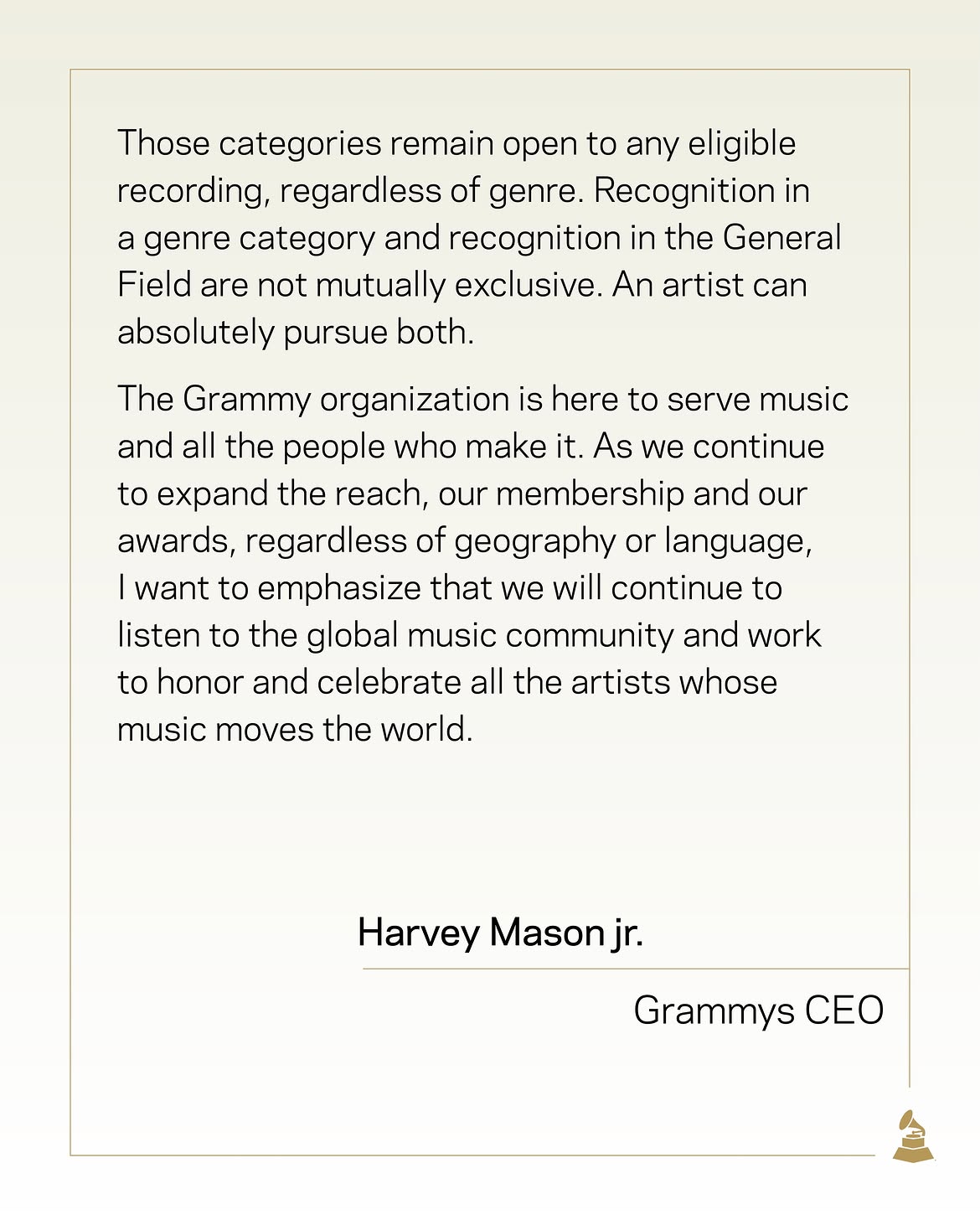
Recording Academy CEO Harvey Mason Jr. responded by saying he respected BTS' decision, even though he was disappointed. He clarified that the new Asian Pop category was not intended to keep performers apart from the main competition, but rather to honour the diversity of Asian music. Mason also clarified that artists eligible for genre categories can still compete for the Grammys' biggest honours, including Album of the Year, Record of the Year and Song of the Year, if their submissions qualify.
Even with that clarification, BTS' boycott has become one of the most significant Grammy debates in recent years. The group has decided to use its global popularity to challenge how foreign artists are acknowledged on one of the largest stages in music, instead of running for another nomination.
Whether the Recording Academy revisits its approach remains to be seen, but BTS' message has already shifted the conversation from winning awards to redefining what equal recognition in global music should look like.
Also Read: Why Is BTS' 'SWIM' Being Sued? Inside the US Plagiarism Lawsuit Against HYBE